




















































































Blackjack Basic Strategy Card Instructions
Our credit-card-sized blackjack strategy cards are durable solid plastic, and offer optimized strategies for six different sets of casino rules.

Wallet-size blackjack strategy cards tailored specifically for each set of rules. Available individually, or in a set of all six.
The full 6-card set includes:
-
1 Deck, Dealer Stands on all 17s
-
1 Deck, Dealer Hits Soft 17
-
2 Decks, Dealer Stands on all 17s
-
2 Decks, Dealer Hits Soft 17
-
4/6/8 Decks, Dealer Stands on all 17s
-
4/6/8 Decks, Dealer Hits Soft 17
-
Each card features perfect basic strategy from BlackjackInfo.com
-
Small credit-card sized charts for easy use at the casino table.
-
Solid plastic for durability, small enough to fit in your wallet.
Also available here are the Advanced Strategy Cards, which include card counting index numbers.
Instructions:
Step 1: Choose the correct strategy card.
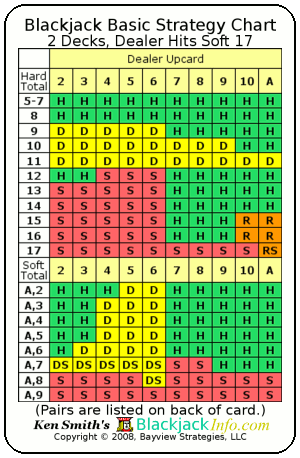
Number of Decks: Determine how many decks are in use at the particular game you are playing. If you are not sure, just ask the dealer.
Our strategy cards come in 1 deck, 2 deck and 4/6/8 deck versions. Use the 4/6/8 deck chart for any number of decks over two. For example, some continuous shuffler games use 5 decks of cards.
Dealer Hits or Stands on Soft 17? Some casinos offer games where the dealer must stand on all 17s, while others require the dealer to take another card if they have a “soft 17”. The tabletop felt should include wording that says either “Dealer Stands on All 17s” or “Dealer Hits Soft 17”. Use this information to choose the correct strategy card.
What is a soft 17? A “soft” hand is a hand that includes an Ace and cannot bust if you take another card. A hand of (Ace,6) is a soft 17. A hand of (3,Ace,3) is also a soft 17. However, the hand (3,Ten,Ace,3) is not a soft 17 even though it includes an Ace.
For our example here, we’ll assume you are playing a 2 deck game, and the wording on the table indicates that the dealer hits soft 17.
Number of Decks: Determine how many decks are in use at the particular game you are playing. If you are not sure, just ask the dealer.
Our strategy cards come in 1 deck, 2 deck and 4/6/8 deck versions. Use the 4/6/8 deck chart for any number of decks over two. For example, some continuous shuffler games use 5 decks of cards.
Dealer Hits or Stands on Soft 17? Some casinos offer games where the dealer must stand on all 17s, while others require the dealer to take another card if they have a “soft 17”. The tabletop felt should include wording that says either “Dealer Stands on All 17s” or “Dealer Hits Soft 17”. Use this information to choose the correct strategy card.
What is a soft 17? A “soft” hand is a hand that includes an Ace and cannot bust if you take another card. A hand of (Ace,6) is a soft 17. A hand of (3,Ace,3) is also a soft 17. However, the hand (3,Ten,Ace,3) is not a soft 17 even though it includes an Ace.
For our example here, we’ll assume you are playing a 2 deck game, and the wording on the table indicates that the dealer hits soft 17.
Step 2: Find the row for your hand on the card.
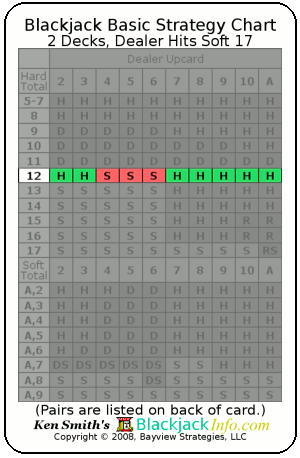 Once you’ve chosen the right strategy card, refer to it whenever you encounter a hand for which you are not sure of the best strategy. Each card is split into three major sections. On the front side of the card you’ll find sections for both hard and soft total hands that are not pairs. On the back of the card you’ll find complete advice for playing hands that are pairs.
If your two card hand is a pair of two cards of the same rank, refer to the “Pairs” section on the back of the card. If your two card hand includes an Ace, refer to the front of the card in the section “Soft Totals”. If your two-card hand does not include an Ace, find your hand total under “Hard Totals”. In each case, find the row that corresponds to your hand.
For example, let’s say you are dealt the hand (9,3) and the dealer shows a three up. Since your hand is not a pair, and it does not include an Ace, look for your total (9+3 = 12) in the Hard Totals section, as indicated here.
Once you’ve chosen the right strategy card, refer to it whenever you encounter a hand for which you are not sure of the best strategy. Each card is split into three major sections. On the front side of the card you’ll find sections for both hard and soft total hands that are not pairs. On the back of the card you’ll find complete advice for playing hands that are pairs.
If your two card hand is a pair of two cards of the same rank, refer to the “Pairs” section on the back of the card. If your two card hand includes an Ace, refer to the front of the card in the section “Soft Totals”. If your two-card hand does not include an Ace, find your hand total under “Hard Totals”. In each case, find the row that corresponds to your hand.
For example, let’s say you are dealt the hand (9,3) and the dealer shows a three up. Since your hand is not a pair, and it does not include an Ace, look for your total (9+3 = 12) in the Hard Totals section, as indicated here.
Step 3: Find the dealer’s upcard column.
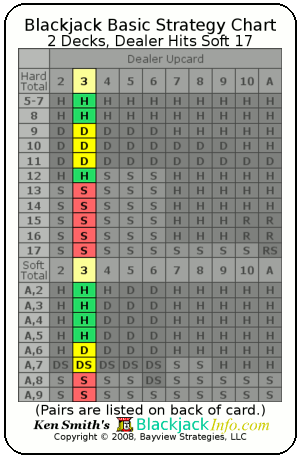 Now find the dealer’s upcard to identify which column you should use. In our example, the dealer has a three showing. Dealer upcards of Ace are shown as “A” on the cards. Dealer upcards of Ten, Jack, Queen and King are all treated as a value of ten, indicated on our charts as a ‘T’.
Our example is for the dealer having a three as the upcard.
Now find the dealer’s upcard to identify which column you should use. In our example, the dealer has a three showing. Dealer upcards of Ace are shown as “A” on the cards. Dealer upcards of Ten, Jack, Queen and King are all treated as a value of ten, indicated on our charts as a ‘T’.
Our example is for the dealer having a three as the upcard.
Step 4: Locate the strategy at the intersection.
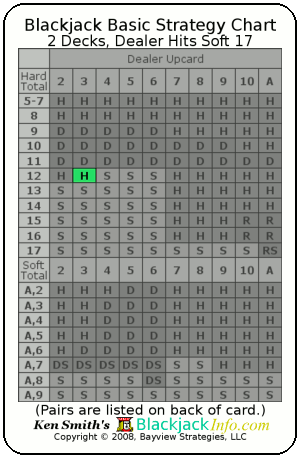 Now that you have located the appropriate row (your hand) and column (the dealer’s upcard), the appropriate strategy appears at the intersection.
For our example hand of (9,3) vs a dealer 3, that’s here:
There are many different possible values indicated on the strategy chart, so we’ll look at each possible notation: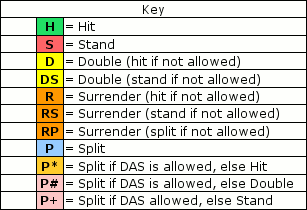
- Hit: Hit your hand (ask for another card).
- Stand: Stand and keep your current hand.
- Double: Double Down (double your original bet and receive one more card). Note the two varieties D and DS, indicating what to do if doubling is not allowed.
- Surrender: Surrender and fold your hand to receive half your bet back.
- Split: Split your two initial cards of the same rank to make two separate hands. Note that some splits are appropriate only if Double After Splitting (DAS) is allowed. (Recent printings of the cards have separate tables for DAS and No DAS, making this even simpler.)
Now that you have located the appropriate row (your hand) and column (the dealer’s upcard), the appropriate strategy appears at the intersection.
For our example hand of (9,3) vs a dealer 3, that’s here:
There are many different possible values indicated on the strategy chart, so we’ll look at each possible notation:
- Hit: Hit your hand (ask for another card).
- Stand: Stand and keep your current hand.
- Double: Double Down (double your original bet and receive one more card). Note the two varieties D and DS, indicating what to do if doubling is not allowed.
- Surrender: Surrender and fold your hand to receive half your bet back.
- Split: Split your two initial cards of the same rank to make two separate hands. Note that some splits are appropriate only if Double After Splitting (DAS) is allowed. (Recent printings of the cards have separate tables for DAS and No DAS, making this even simpler.)
Buy a set of the Basic Strategy Cards now.
Ready to take your game to the next level? Check out our Advanced Blackjack Strategy Cards, that include optimal Hi-Lo card counting index numbers right on the card.
Use these Blackjack Strategy Charts to learn the correct decision for every hand. Basic Strategy is the first step to beating blackjack with card counting
This site only collects related articles. Viewing the original, please copy and open the following link:Blackjack Basic Strategy Card Instructions