

























































How to Count Cards - Blackjack Card Counting Strategy (with pics)

Learn how to count cards in blackjack ✅ Step by Step Guide ✅ True Count ✅ Best Card Counting Strategy. Play responsibly 18+

Last updated July 23, 2024Written by: Daniel Grant

  • What is card counting?
  • How to count cards
  • Card counting tips
  • Summary

Once you’ve learned the rules of blackjack, then mastered basic strategy, you might be tempted to learn how to count cards in blackjack.

Counting cards is the stuff of blackjack folklore and although it’s more of an intellectual challenge than a way to make a living these days, counting cards still has the potential to eliminate the house edge.

Card counting gives you a better idea of which cards are left in the deck, and how to use that info to your advantage.

A deck full of higher value cards is good for players, as it’s easier to make Blackjack. A deck rich in lower value cards is bad for players.

When you know if a deck has become better or worse, you can increase or decrease your bet size, and make some alternative strategy decisions too.

Fortunately for players looking to learn how to card count in blackjack, you won’t need to memorise every card that’s dealt. Card counting methods assigns a point value to each card, so you can keep a running tally.

With the ideal combination of table rules, a player who accurately counts cards can gain a 2-4% edge over the house in a game that normally has a 0.50% advantage for the casino.

But before you invest your time and money into a career in card counting, you should know that this method works best in single-deck games which are rare. Also, land-based casinos are always on the look-out for experienced counters, so the chances are you won’t have much time to cash in before they ask you to leave.

How does it work?

In blackjack, players at the table will see several hands before the deck is shuffled. Once part of the deck has been dealt, it’s possible to calculate what’s left in the deck.

In the simplest terms, if you know that no more Aces are left in the deck, it’s impossible to make Blackjack and the smart play is to pack up and leave. A deck with fewer cards worth 10 will also increase the house edge, as it’s harder to make Blackjack, harder to make high hands like 20, and the dealer busts less often.

On the flipside, a deck with fewer Sixes lowers the house edge. This is partly because you make fewer weak starting hands, and because the deck is now stacked with bigger cards. The dealer will bust more often too.

In common card counting systems, each card is assigned a positive, negative or neutral value , depending on the effect its removal has on the rest of the game. In most systems, Aces and cards worth 10 (Kings, Queens, Jacks and Tens) are negative, 2s to 6s are positive and the rest are neutral.

A positive count tells us that more low cards have been removed and fewer are left in the deck. This means the rest of the deck is rich in high cards which are more valuable to the player. A negative count happens when more high cards have been dealt, leaving a deck full of low cards which are of more use to the house.

How to count cards

Assuming you already know how to play blackjack and have your blackjack basic strategy nailed down, card counting involves 4 steps, all of which are critical if you’re to get any benefit from a blackjack counting system.

Step 1: Learn the point values

All card counting systems assign a points value to each card in the deck. Remember, suits mean nothing in blackjack so it’s the card counting value of the card that matters. These points aren’t to be confused with the value of each card in blackjack itself. A jack is always worth 10 in blackjack when you are calculating the value of your hand, but when you are counting cards, it’s got a points value of -1.

Card Counting Points Values

Ace through Ten: -1 point

7 to 9: 0 points

2 to 6: +1 point

Here’s a nice little graphic to help you remember this. It takes a bit of practice! It’s also weird that good cards get a negative score, but that’s because high cards are good for you, and bad for the dealer, and so you want more good cards to stay in the deck. The more good cards that come out, the less there are in the deck.
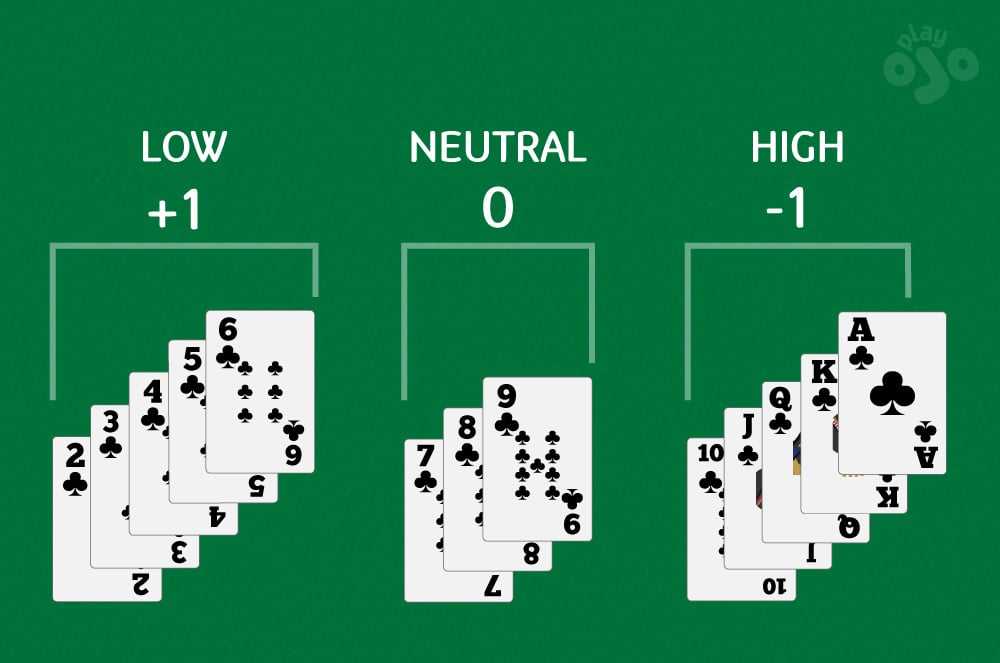
every card rank and their points value

Step 2: Keep a running count

It’s one thing to know the points value, but you also need to keep track of how the deck is doing overall. That means keeping what’s called a “running count” – the cumulative total of points. The count always starts at zero after the deck is shuffled, and you add or subtract 1 point every time a card is dealt that you can see. It’s not just your cards either – you use every card on the table whose value you can see. That means your cards, whatever cards other players are dealt, and the dealer’s cards.

In the example below, you can see a sequence of cards dealt at a blackjack table, the card count value for each card and the running count, which ends in a final count of -1.
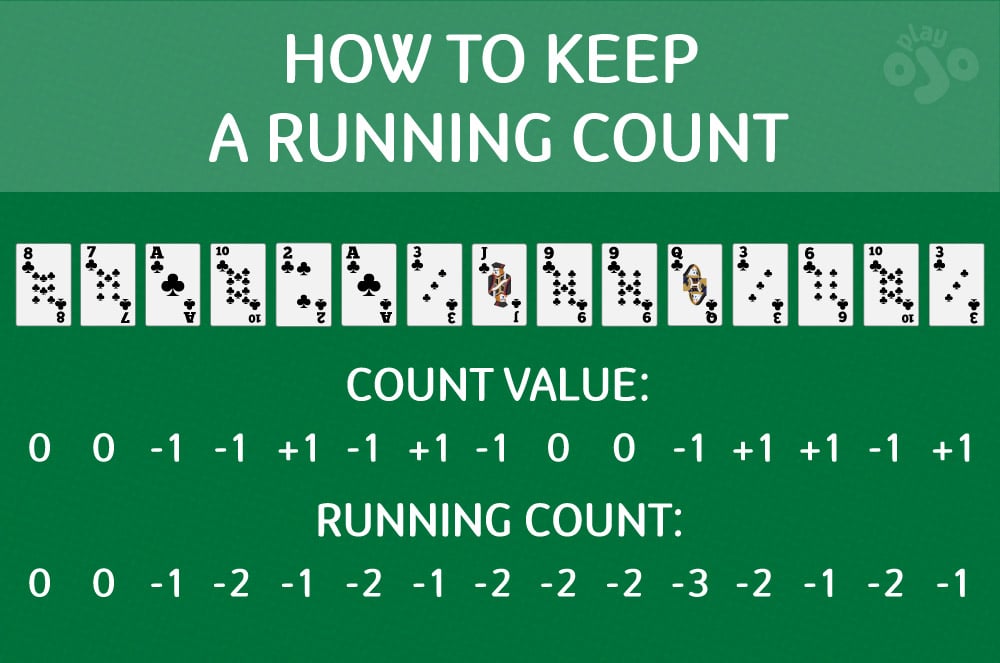
a row of playing cards, with their value and the running count underneathKeeping an accurate running count is the most important skill in card counting. With enough practice in a live casino environment, it should become second nature.

This step is by far the one that requires the most practice. But there are some little tips that counters use to help them count at speed, like counting some cards in pairs. For instance, any hand which uses two cards worth 20 e.g. K-Q, is worth -2 points to the running count. Blackjack hands with a high card and a low card e.g. 10-2 will cancel each other out and can quickly be ignored.

Step 3: Calculate the true count

In a single-deck game, the running count is all you need to determine whether to bet big or small. But if you’re playing a game which uses multiple decks, like most blackjack games in the UK, you have to divide the running count by the number of decks remaining in the shoe.
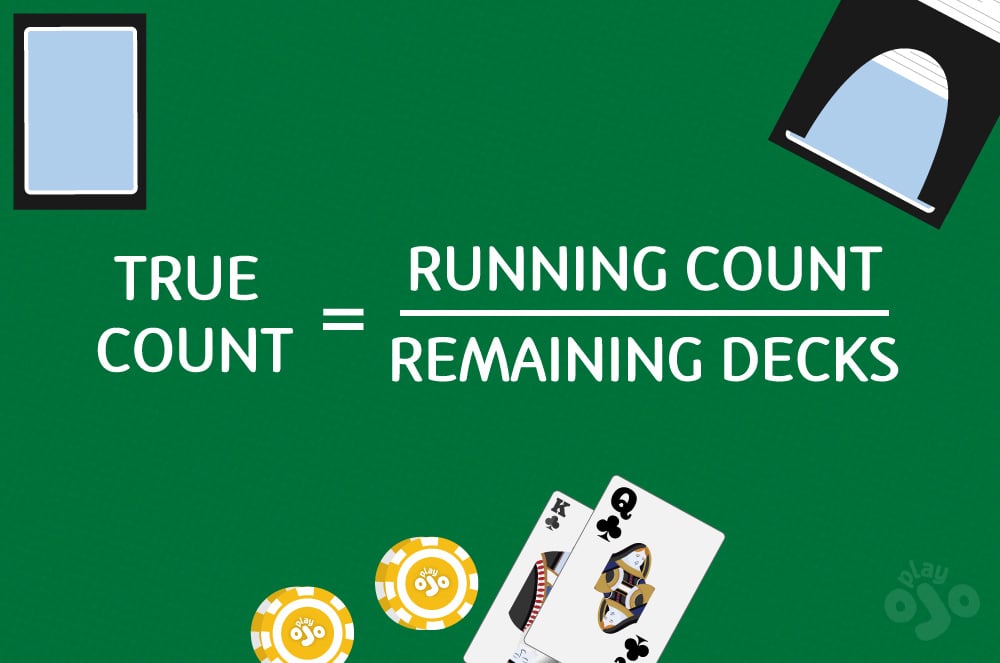
equation “true count = running count / remaining decks”To find out the true count, you need to know:

  1. How many decks are being used
  2. The running count
  3. How many decks have been dealt so far Take an 8-deck game where the running count is -3, the dealer has dealt roughly 2 decks and there are 6 decks left in the shoe. Here’s how we calculate the true count:

-3 divided by 6 = -0.5

How do you know how many decks are left in the shoe?

A quick look at the discarded cards will tell you roughly how many decks have been dealt (to the nearest full or half deck). Unlike the more mathematical and clear cut elements of card counting, this part comes down to experience.

Step 4: Choose your bet size

After the first 3 steps, you will know the true count – whether the deck is good or bad for you. Now you have to act on that information.

Card counting enables you to bet bigger when the deck is favourable to you, and smaller when it’s unfavourable.

You won’t see a high true count very often, so it’s vital that you take advantage when it happens. That usually means betting the maximum that your bankroll management rules allow. There are many different betting strategies for counting cards in blackjack. Here’s a simple one that ranges from half your usual bet, to 8x your bet.
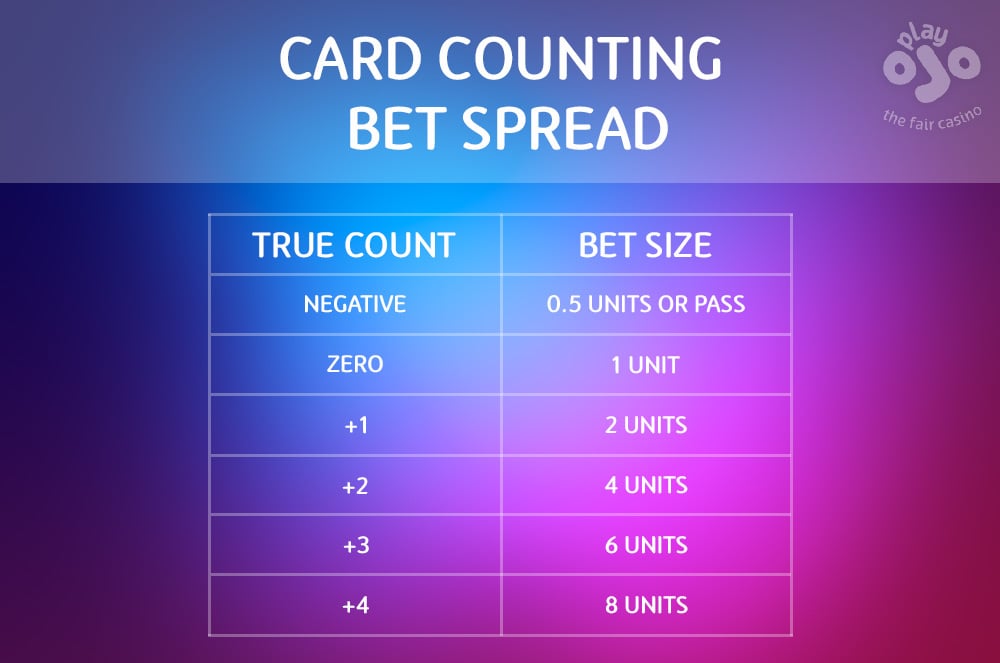
CARD COUNTING BET SPREADBefore you even take your seat, you should decide what your ‘unit’ bet should be. That’s the standard bet you make in every hand, and ideally it should be a very small percentage of your total bankroll for this session e.g. 1%. So if you came with £200 to play with, your unit bet should be roughly £2. Some players take a more aggressive approach to bankroll management and bet 5% per hand.

If the count goes negative, either reduce your stake, sit out the hand or move tables.

If the count goes positive, it’s time to bet more units. The higher the count, the more units you bet. The range of bet sizes is called the ‘spread’, and can include as few as 4 points or as many as 15 points. Many systems will recommend a maximum bet of 4 times your unit bet, while other common betting strategies involve subtracting 1 from the true count and multiplying the resulting number by your unit bet. Choose a betting strategy that is simple enough for you to remember, as you’ll have to keep track of the card values, running count, true count and betting model!

  1. Ensure you have enough chips to cover a long run of bad luck, and prevent emotion creeping in. Not having the funds or the courage to place a maximum bet when the count is high is one of the worst blackjack mistakes a counter can make.

Step 5: Adapt your basic strategy
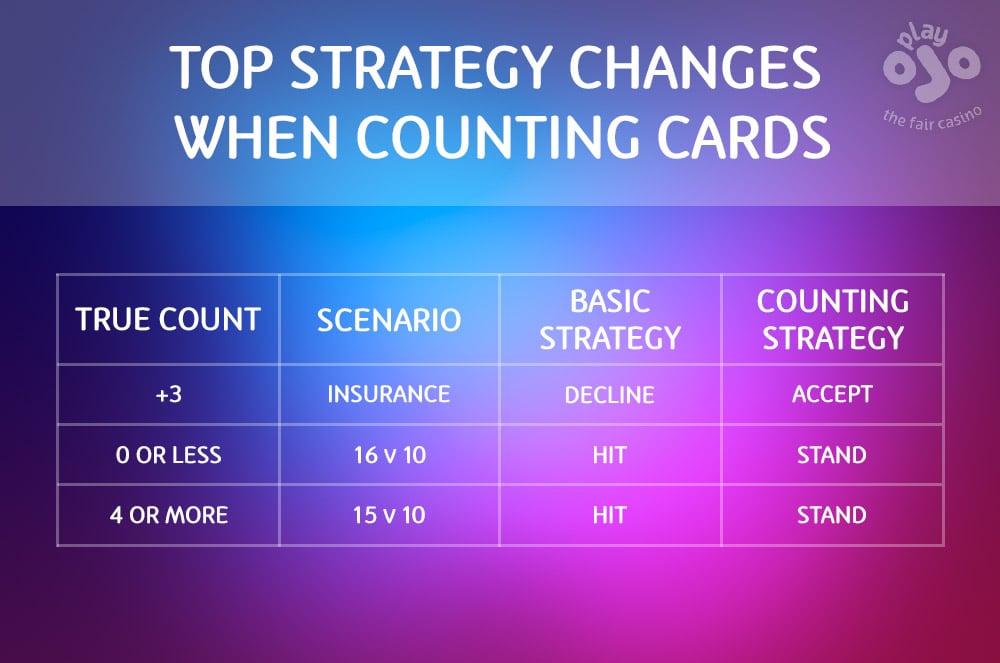
TOP STRATEGY CHANGES WHEN COUNTING CARDSBetting big or small depending on the true count is the first step towards card counting success. But there are also a few situations where you can change your basic strategy too. That means adapting your decisions in situations like blackjack insurance, doubling down and splitting.

In general, counting strategy changes are possible when:

  • Count is +3 or better:

  • Take insurance

  • Stand on 15 and 16 against a 10

  • Double down more aggressively

  • Splitting pairs such as Tens which would normally stand

  • Count is -3 or worse:

  • Double down less often in marginal situations

  • Hit hands such as 12 against a 6 which would normally stand

There’s a lot to remember when you are trying to count cards in blackjack, so don’t worry if you can’t manage this part too. I see it as the cherry on the cake, or something for more experienced counters.

Step 6: Disguise your play
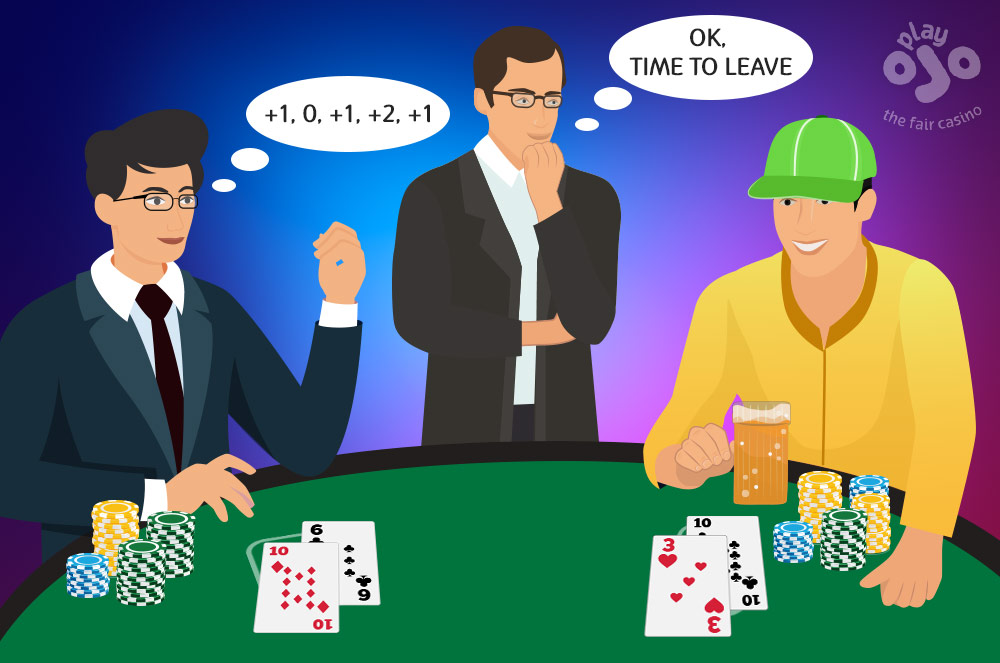
There’s nothing illegal about counting cards in online blackjack, and frankly online casinos don’t care at all. But if you are trying to count cards in a real casino – especially one with favourable rules like single deck, then you may want to avoid alerting them to what you’re doing.

If you only play when the deck is good, and sit out when it’s not, I can imagine plenty of pit bosses asking you to leave.

There are several tricks to ensure you fly under the radar: 54. Be inconspicuous. Play the role of a classic recreational blackjack player. Try not to study the cards or look like you’re at work. Play side bets even though the odds are not in your favour. Order an alcoholic drink, even if you don’t drink it. 55. Avoid classic counting tells. Don’t join midway through a shoe or leave once the count goes negative. Sit in the middle of the table rather than 1st or 3rd base. 56. Bet conservatively. If you want to visit the same casino again, it’s better to play more hands at lower stakes than hit the casino for high stakes. 57. Limit your spread. A 15 point spread means you will be betting 1 unit when the deck is unfavourable and a whopping 15 units when the deck is perfectly packed with Tens. A 5 point spread with a 5 unit maximum will draw less attention. 58. Randomize your play . Casinos are experts in spotting smart blackjack play and betting strategies, and they may also know the true count too. Throwing in some random decisions and bet sizes, even if it cuts into your profit, can help to throw them off your scent. 59. Mix up your gaming. Playing keno or slots on your way into or out of the casino can build your image as a recreational gambler.

My top card counting tips

When Thorp first revealed his basic strategy and card counting method, the conditions were perfect for anyone to try their hand at beating the game. Almost 60 years later, the blackjack landscape has evolved and the casinos are smarter at protecting their profits.

It may still be possible to find a game where card counting can reduce the house edge, but I treat card counting as an intellectual challenge, rather than a way to beat the casino. Whether you’re trying to win money, or just trying to learn a new skill, here are some tips you should bear in mind:

  1. Prepare for a grindIt will take time, effort and perfect execution to reap any rewards. As a card counter, you need to do many things at once; Keep a running count of all cards on the table, play your own hand using basic strategy, follow a bet size strategy and occasionally deviate from your basic strategy. All this while disguising what you’re doing! Although anyone can learn the basics of card counting, pulling it off is both physically and mentally challenging, and ultimately far less glamorous than it sounds!
  2. Scout for the best rulesFind the right table rules for your card counting blackjack game. Counting cards is about as useful as a chocolate teapot if you’re playing a game with a continuous shuffling machine. Look for a set of rules which matches the system you’ve learned. If you’re intending to play lots of blackjack today, it makes sense to be picky about what table you choose, and how long you play.
  3. Play perfect strategyChoosing the right strategy is crucial when you count cards. Counting cards perfectly can reduce the house edge or even gain an edge over the house. But inaccurate counting could lead to even worse losses than if you weren’t counting at all! That may be the reason why, far from fearing the waves of new counters after the release of Thorp’s seminal book, Las Vegas casinos were believed to have welcomed amateur counters. A profitable high count will only occur between 15-35% of the time, and casinos are now wise to the ways of the card counter, so any edge you gain will be small or non-existent.
  4. Cover your tracksTo count cards well, you need to fly under the radar using an effective ‘cover’, as counters call it. If you can’t play the part of a regular gambler while counting accurately, you might as well hit the road. If you’re lucky enough to find a great game, you don’t want to alert the casino before you’ve made a single dime. Counting cards in blackjack should be an automatic process, and much of the skill comes in how you avoid attracting attention. If you can play the part of a happy-go-lucky gambler who likes to split Tens every now and then, you’ll get a warmer welcome and a weightier wallet!
  5. Watch where you sitPick your seat carefully. Sitting in seat 1 (the first seat on the left from the player’s perspective, but the furthest from the dealer in the order of play) is far better than sitting in seat 7. As the last player to act, you get to see more cards which gives you a more accurate count.
  6. The more hands, the betterBy being involved in more of the action at the table, you can control the speed of play and the number of cards that come out. In some very unusual circumstances, expert card counters have sacrificed one hand to learn more about the deck, which they use in their other hand.
  7. Don’t count cards onlineLive Blackjack tables aside, the internet isn’t the right place to practice a card counting blackjack game. These systems are useless when you play classic online blackjack in an online casino because the desk is shuffled every hand by a random number generator.

Summary

So that’s all there is to blackjack card counting. If you want to know how to win at blackjack once you’ve mastered the basics or just want to take your play to the next level, counting cards is a great skill to learn. It’s never been a ticket to easy money, but I loved the challenge of learning to count, it still keeps my brain sharp at the table and gives this game an extra layer of interest.

FAQ

What does true count mean in card counting?In blackjack, the true count is a number that represents whether the remaining decks have more or less tens and Aces than usual. True counts can be positive, like +3, negative, like -1, or even. When the true count is positive, card counters increase their bet size, because they are more likely to be dealt good hands, and the dealer is more likely to bust.

Can you beat blackjack by counting cards?Blackjack has a very small house of edge of less than 1%, provided you play the optimal decisions. Counting cards can gain a few percent, so they actually have an edge over the house, but only at tables with very specific rules, usually single-deck games. In the UK, casinos use multiple decks and shuffling machines, so there are no longer any blackjack games, offline or online, where counting cards will give you an edge over the house.

How hard is it to count cards in blackjack?Counting cards is one of the toughest skills to master in the whole casino world. It can take hundreds of hours of practice before you can count cards on autopilot, without making any mistakes. Counting cards is only useful if you do it perfectly, as an incorrect count can lead a player to bet more in a situation where the deck is actually unfavourable.

Is card counting legal?In the UK, it is not illegal to count cards at a blackjack table, although some casinos may still prefer that you don’t. The worst that can happen is that a casino may ask you to stop, or ask you to leave.

What is counting cards?In blackjack card counting is a method of keeping track of which cards are dealt, so players know when the cards left in the deck are favourable, or unfavourable. It helps card counters to bet more when the deck has more high cards, and bet less if the deck has more low cards.

Dan Grant has been writing about gambling for 15 years, and been fascinated by beating the odds for even longer. Now he’s on a mission to help others bet smarter and avoid the mistakes he made. When he’s not obsessing over bankroll strategy or counting cards badly, he’s hosting The OJO Show podcast.

When to surrender in blackjack

When to surrender in blackjack

Last updated September 16, 2024by: Daniel Grant

The 21+3 Blackjack Side Bet

The 21+3 Blackjack Side Bet

Last updated May 23, 2024by: Sarah McIver

The Ultimate Blackjack Terms Glossary\u00a0The Ultimate Blackjack Terms Glossary\u00a0

The Ultimate Blackjack Terms Glossary

Last updated July 22, 2024by: Daniel Grant

Last updated September 16, 2024by: Daniel Grant

Last updated May 23, 2024by: Sarah McIver

Last updated July 22, 2024by: Daniel Grant

This site only collects related articles. Viewing the original, please copy and open the following link:How to Count Cards - Blackjack Card Counting Strategy (with pics)

Latest Articles Popular Articles
Recommended Articles

Card Counting 101

Learn the basics of card counting how to get started and why its important for casino staff to learn this.

Whats the Best Card Counting System? - Gambling With An Edge

September 12, 2022Leave a Comment Written by Arnold Snyder A Comparison of the Top 100 By Arnold Snyder(From Blackjack Forum Volume I #3, September 1981)© Blackjack Forum 1981 Note to players from Arnold Snyder: This is a technical article on the way professional blackjack players and count system developers compare card counting systems. If you’re new to card counting, and are looking for your first card-counting system, I recommend you start with our Intro to Winning Blackjack article. There are links in that article to several card counting systems, from the easiest system I’ve ever seen to a full professional-level system, as well as information for new card counters on how to choose the best system for you. A number of blackjack players have written me asking my opinion of the “best” card counting system. This is a loaded question. As I mentioned in Blackjack Forum #I I have been using the Hi-Opt II count, because I like its power and simplicity for my ability and style of play. Note from A.S.–Soon after this article was written I switched to the Zen Count for single deck play. When I began shuffle tracking, I switched to the Hi Lo Lite Count. Complete information about both counts is provided in Blackbelt in Blackjack. If you are using a card counting system with which you are comfortable, and you feel you can play it accurately, then stick with it. There is more money to be made by finding and exploiting lucrative table conditions than by “upgrading” your card counting strategy. Your “act” is more important than any amount of complex mental arithmetic you do at the tables. Card counting is automatic and boring once you know your system. This is as it should be, so that you may apply your efforts to the more important work of pretending to be a non-card-counter; engaging dealers and pit-bosses in conversation; flirting with cocktail waitresses; acting engrossed in the Keno board, etc. Some players find card counting easy, and/or are so dedicated to practice that they can accurately apply higher level card-counting strategies. By a “higher level count,” I mean a count that assigns card values other than +1, -1, or 0. A “multi-parameter count,” on the other hand, is one that keeps separate running counts for various cards. I am of the opinion that the most difficult higher level single parameter card counting system (i.e. – no “side counts”) are easier to play with accuracy, than the “simplest” level one multi-parameter card counting systems. Most card counters, including serious professionals, should stick with level one single-parameter card counting systems. Some players may obtain a slightly greater advantage by applying a higher level single-parameter count strategy. I’ve analyzed more than 100 different single-parameter systems, including both those that are currently available and some that are purely theoretical to determine the “best”, in terms of potential returns on the dollar. The Search for the Best Card Counting System: MethodologyMy method of comparing systems is to apply the “Blackjack Formula,” inserting the various systems’ playing efficiencies and betting correlations. If you have my book, The Blackjack Formula, see page 54 for such a comparison of eight popular card counting systems. In this comparison, I tested each system vs. Vegas Strip rules in a singledeck game with a 1 to 4 betting spread, and 60%, 70% and 80% of the cards dealt out. I’ve similarly tested many other actual and hypothetical card counting systems in both single and multi-deck games, assuming various betting spreads. Although differences between systems are slight, this methodology allows card-counting systems to be ranked by profit potential with relative accuracy if we assume accurate strategy tables are being used. What I’ve found is that the higher-level systems perform at a rate of profit of about .1% better than the level one systems. My method of computing the playing efficiencies and betting correlations of the various systems is explained in The Blackjack Formula (pages 85 through 90). My method is a simplification of Peter Griffin’s method in Theory of Blackjack, and for all practical purposes, is just as accurate. The card counting systems that I analyzed in seeking the best ranged from level one through level four (i.e., I did not attempt to analyze any count system with values greater than +4). There appears to be no practical reason for employing a count system greater than a level two. I could find no significantly better count than that which applies the following values: A 2 3 4 5 6 7 8 9 X -1 +1 +1 +2 +2 +2 +1 0 0 -2 This count, which I will dub the Zen Count, has a playing efficiency of .63 and a betting efficiency of .97. Curiously, the ace, valued at -1, is not neutralized (valued 0), but “half” neutralized. In other words, I have “taken the middle road. – a zen approach. It is this trick that keeps the betting efficiency high, while maintaining a very respectable playing efficiency. The following table shows how various counts rank, according to the Blackjack Formula, assuming a 1-to-4 spread, single-deck game, Vegas Strip rules, dealt out 70% between shuffles: System Rate of Profit Zen Count 2.00 Uston APC 1.98 Revere APC ’73 1.97 Wong Halves 1.96 Hi-Opt II 1.96 Canfield Master 1.96 Revere Point Count 1.95 Uston Adv. +/- 1.89 Canfield Expert 1.88 Hi-Lo 1.87 Hi-Opt I 1.86 Revere +/- 1.86 Andersen Count 1.80 DHM (Simple) 1.78 The top-ranked (level two) Zen Count is simpler than any of the next three counts which are level 3, level 4, and level 3, respectively. As I noted earlier, I use the Hi-Opt II count. My reason for this is that the gain from using the Zen Count is very slight, and frankly Hi-Opt II is slightly simpler. I’m a great believer in simplicity. Nor could I say for certain that the Zen Count is undeniably superior. The Blackjack Formula indicates a negligible superiority under most conditions. Of academic interest, the best single parameter card counting systems are those numbered #91, #92, #93 and #94. These systems represent the upper limit of single parameter systems which score high in both playing efficiency and betting correlation. All of these systems employ the same device of not-quite-neutralizing the Ace. Although I believe it would be easier to play one of these level four single-parameter systems accurately, than it would be to play any multi-parameter system, I would not advise any player to mess with one of these monsters. The potential gain from using one of these counts, compared to that of the relatively simple Zen count, is negligible. For instance, in the Vegas Strip game used in the prior comparison, in which the Blackjack Formula predicts the Uston APC would win at a rate of 1.98% and the Zen Count would win 2.00%, any one of the level four counts would win at a rate of only 2.02%. The Blackiack Formula, to be fair, is not actually accurate enough to make such a fine comparison. But count #92, which has a playing efficiency of .67, and a betting correlation of .95, would undeniably rank higher than Hi-Opt II, which also has a playing efficiency of .67, but a betting correlation of only .91. The following table lists the playing efficiencies and betting correlations of 100 selected card counting systems (with sincere thanks to Brian Gothberg for writing the computer program that generated these results). Count 2 3 4 5 6 7 8 9 X A PE BC 1 0 0 0 1 0 0 0 0 0 -1 .05 .53 2 1 1 1 1 0 0 0 0 -1 0 .56 .86 3 0 1 1 1 1 0 0 0 -1 0 .61 .88 4 0 0 1 1 1 1 0 0 -1 0 .64 .85 5 1 1 1 1 1 0 0 0 -1 -1 .51 .97 6 0 1 1 1 1 1 0 0 -1 -1 .55 .95 7 1 1 1 1 1 0 0 -1 -1 0 .59 .92 8 0 1 1 1 1 1 0 -1 -1 0 .63 .89 9 1 1 1 1 1 1 0 -1 -1 -1 .54 .98 10 0 0 1 1 0 0 0 0 0 -2 .05 .58 11 0 0 2 2 0 0 0 0 -1 0 .49 .78 12 0 0 1 2 1 0 0 0 -1 0 .57 .83 13 0 1 1 2 1 0 0 0 -1 -1 .51 .94 14 0 0 1 2 1 1 0 0 -1 -1 .53 .91 15 0 1 1 2 1 0 0 -1 -1 0 .57 .89 16 0 0 1 2 1 1 0 -1 -1 0 .59 .86 17 0 0 2 2 1 0 0 0 -1 -1 .47 .89 18 0 0 2 2 1 0 0 -1 -1 0 .53 .84 19 1 1 1 2 1 0 0 -1 -1 -1 .51 .97 20 0 1 1 2 1 1 0 -1 -1 -1 .54 .96 21 0 1 2 2 1 0 0 -1 -1 -1 .49 .94 22 0 0 2 2 2 0 0 -1 -1 -1 .46 .89 23 1 1 1 2 1 0 0 0 -1 -2 .4 .96 24 0 1 1 2 1 1 0 0 -1 -2 .43 .94 25 0 1 2 2 1 0 0 0 -1 -2 .4 .93 26 0 0 2 2 2 0 0 0 -1 -2 .38 .88 27 1 1 1 2 1 1 0 -1 -1 -2 .45 .98 28 1 1 2 2 1 0 0 -1 -1 -2 .41 .97 29 1 1 1 1 1 1 1 -1 -1 -2 .43 .94 30 0 1 2 2 2 0 0 -1 -1 -2 .41 .93 31 0 1 2 2 1 1 0 -1 -1 -2 .44 .95 32 0 0 2 2 2 1 0 -1 -1 -2 .42 .91 33 1 1 1 1 1 1 1 1 -2 1 .61 .72 34 1 1 1 1 1 1 1 1 -2 0 .61 .8 35 1 1 1 2 1 1 1 0 -2 0 .67 .88 36 1 1 2 2 1 1 0 0 -2 0 .67 .91 37 1 1 2 2 2 0 0 0 -2 0 .63 .9 38 0 1 2 2 2 1 0 0 -2 0 .66 .89 39 0 2 2 2 2 1 0 -1 -2 0 .65 .91 40 1 1 2 2 2 1 0 -1 -2 0 .67 .93 41 1 2 2 2 2 0 0 -1 -2 0 .62 .92 42 1 1 2 2 2 1 0 0 -2 -1 .63 .97 43 1 2 2 2 2 0 0 0 -2 -1 .58 .95 44 0 2 2 2 2 1 0 0 -2 -1 .61 .94 45 1 2 2 2 2 1 0 -1 -2 -1 .62 .98 46 2 2 2 2 2 0 0 -1 -2 -1 .57 .97 47 0 2 2 2 2 2 0 -1 -2 -1 .62 .95 48 1 2 2 2 2 1 0 -2 -2 0 .63 .93 49 1 2 2 2 2 1 0 0 -2 -2 .56 .99 50 2 2 2 2 2 1 0 -2 -2 -1 .59 .97 51 2 2 2 2 2 1 0 -1 -2 -2 .55 1 52 1 2 2 2 2 2 0 -2 -2 -1 .61 .96 53 1 2 2 2 2 2 0 -1 -2 -2 .57 .99 54 2 2 2 2 2 1 0 0 -2 -3 .48 .98 55 1 2 2 2 2 2 0 0 -2 -3 .49 .97 56 1 2 2 3 2 1 0 0 -2 -3 .49 .98 57 1 2 3 3 2 0 0 0 -2 -3 .46 .97 58 1 2 3 3 1 1 0 0 -2 -3 .48 .97 59 1 1 3 3 2 1 0 0 -2 -3 .49 .97 60 0 2 3 3 2 1 0 0 -2 -3 .48 .96 61 0 2 3 3 3 0 0 0 -2 -3 .45 .94 62 1 2 2 3 2 1 0 -1 -2 -2 .57 1 63 1 2 3 3 2 0 0 -1 -2 -2 .53 .98 64 0 2 3 3 2 1 0 -1 -2 -2 .55 .97 65 1 2 3 3 2 1 0 -1 -2 -3 .5 1 66 1 2 3 3 2 1 0 0 -3 0 .66 .92 67 2 2 2 3 2 1 0 0 -3 0 .66 .92 68 2 2 3 3 2 0 0 0 -3 0 .63 .91 69 1 2 3 3 3 0 0 0 -3 0 .63 .9 70 1 2 3 3 2 2 0 -1 -3 0 .68 .93 71 2 2 3 3 2 2 0 -1 -3 0 .67 .94 72 2 2 3 3 3 1 0 -1 -3 0 .66 .94 73 1 2 3 3 3 2 0 -2 -3 0 .67 .93 74 1 2 3 3 2 2 0 0 -3 -1 .65 .95 75 2 2 3 3 2 2 0 0 -3 -1 .64 .96 76 2 2 3 3 3 1 0 0 -3 -1 .63 .96 77 1 2 3 3 2 2 0 0 -3 -2 .61 .97 78 2 2 3 3 3 2 0 -1 -3 -2 .62 .99 79 2 2 3 3 3 2 0 0 -3 -3 .56 .99 80 2 3 3 3 3 2 0 -1 -3 -3 .57 1 81 1 2 3 4 2 1 0 -1 -3 0 .66 .93 82 2 2 3 4 2 1 0 -2 -3 0 .65 .94 83 2 2 3 4 2 2 0 -2 -3 -1 .64 .97 84 2 2 3 4 3 2 0 -2 -3 -2 .61 .99 85 2 2 3 4 3 2 0 -1 -3 -3 .58 1 86 2 3 3 4 3 2 0 -1 -3 -4 .53 1 87 2 3 3 4 3 2 0 -1 -4 0 .68 .93 88 2 3 3 4 3 2 0 0 -4 -1 .66 .95 89 2 2 4 4 3 2 0 0 -4 -1 .66 .95 90 3 3 4 4 2 2 0 -1 -4 -1 .64 .96 91 2 3 4 4 3 2 0 -1 -4 -1 .66 .96 92 2 2 4 4 3 3 0 -1 -4 -1 .67 .95 93 2 3 4 4 3 3 0 -2 -4 -1 .66 .96 94 3 3 4 4 3 2 0 -2 -4 -1 .65 .97 95 3 3 4 4 3 3 0 -2 -4 -2 .63 .98 96 3 3 4 4 3 3 0 0 -4 -4 .56 .99 97 3 3 4 4 4 2 0 0 -4 -4 .56 .99 98 3 3 4 4 4 3 0 -1 -4 -4 .57 1 99 3 3 4 4 3 3 0 -1 -4 -3 .6 .99 100 3 3 4 4 4 2 0 -1 -4 -3 .6 .99 Any player who would like to play what may be the “best” practical card counting system ever devised, may obtain complete strategy tables for the Zen Count (developed by yours truly) in the 2005 edition of Blackbelt in Blackjack. I used the Zen Count myself when playing deeply dealt single deck (back when such games were available at full payouts on naturals). You can find more information on the Zen Count here: Zen Count Indices. If I were still strictly counting cards, I would still be using the Zen Count. However, when I switched to shuffle tracking, I switched to the Hi-Lo Lite count. I made that switch because I wanted an easier count (to allow for the complications added by shuffle tracking) without giving up much power. You can find a link to information on the Hi-Lo Lite at the upper left of this page, with complete information in Blackbelt in Blackjack. ♠ By Arnold Snyder(From Blackjack Forum Volume I #3, September 1981)© Blackjack Forum 1981 Note to players from Arnold Snyder: This is a technical article on the way professional blackjack players and count system developers compare card counting systems. If you’re new to card counting, and are looking for your first card-counting system, I recommend you start with our Intro to Winning Blackjack article. There are links in that article to several card counting systems, from the easiest system I’ve ever seen to a full professional-level system, as well as information for new card counters on how to choose the best system for you. A number of blackjack players have written me asking my opinion of the “best” card counting system. This is a loaded question. As I mentioned in Blackjack Forum #I I have been using the Hi-Opt II count, because I like its power and simplicity for my ability and style of play. Note from A.S.–Soon after this article was written I switched to the Zen Count for single deck play. When I began shuffle tracking, I switched to the Hi Lo Lite Count. Complete information about both counts is provided in Blackbelt in Blackjack. If you are using a card counting system with which you are comfortable, and you feel you can play it accurately, then stick with it. There is more money to be made by finding and exploiting lucrative table conditions than by “upgrading” your card counting strategy. Your “act” is more important than any amount of complex mental arithmetic you do at the tables. Card counting is automatic and boring once you know your system. This is as it should be, so that you may apply your efforts to the more important work of pretending to be a non-card-counter; engaging dealers and pit-bosses in conversation; flirting with cocktail waitresses; acting engrossed in the Keno board, etc. Some players find card counting easy, and/or are so dedicated to practice that they can accurately apply higher level card-counting strategies. By a “higher level count,” I mean a count that assigns card values other than +1, -1, or 0. A “multi-parameter count,” on the other hand, is one that keeps separate running counts for various cards. I am of the opinion that the most difficult higher level single parameter card counting system (i.e. – no “side counts”) are easier to play with accuracy, than the “simplest” level one multi-parameter card counting systems. Most card counters, including serious professionals, should stick with level one single-parameter card counting systems. Some players may obtain a slightly greater advantage by applying a higher level single-parameter count strategy. I’ve analyzed more than 100 different single-parameter systems, including both those that are currently available and some that are purely theoretical to determine the “best”, in terms of potential returns on the dollar. The Search for the Best Card Counting System: Methodology My method of comparing systems is to apply the “Blackjack Formula,” inserting the various systems’ playing efficiencies and betting correlations. If you have my book, The Blackjack Formula, see page 54 for such a comparison of eight popular card counting systems. In this comparison, I tested each system vs. Vegas Strip rules in a singledeck game with a 1 to 4 betting spread, and 60%, 70% and 80% of the cards dealt out. I’ve similarly tested many other actual and hypothetical card counting systems in both single and multi-deck games, assuming various betting spreads. Although differences between systems are slight, this methodology allows card-counting systems to be ranked by profit potential with relative accuracy if we assume accurate strategy tables are being used. What I’ve found is that the higher-level systems perform at a rate of profit of about .1% better than the level one systems. My method of computing the playing efficiencies and betting correlations of the various systems is explained in The Blackjack Formula (pages 85 through 90). My method is a simplification of Peter Griffin’s method in Theory of Blackjack, and for all practical purposes, is just as accurate. The card counting systems that I analyzed in seeking the best ranged from level one through level four (i.e., I did not attempt to analyze any count system with values greater than +4). There appears to be no practical reason for employing a count system greater than a level two. I could find no significantly better count than that which applies the following values: A 2 3 4 5 6 7 8 9 X -1 +1 +1 +2 +2 +2 +1 0 0 -2 This count, which I will dub the Zen Count, has a playing efficiency of .63 and a betting efficiency of .97. Curiously, the ace, valued at -1, is not neutralized (valued 0), but “half” neutralized. In other words, I have “taken the middle road. – a zen approach. It is this trick that keeps the betting efficiency high, while maintaining a very respectable playing efficiency. The following table shows how various counts rank, according to the Blackjack Formula, assuming a 1-to-4 spread, single-deck game, Vegas Strip rules, dealt out 70% between shuffles: System Rate of Profit Zen Count 2.00 Uston APC 1.98 Revere APC ’73 1.97 Wong Halves 1.96 Hi-Opt II 1.96 Canfield Master 1.96 Revere Point Count 1.95 Uston Adv. +/- 1.89 Canfield Expert 1.88 Hi-Lo 1.87 Hi-Opt I 1.86 Revere +/- 1.86 Andersen Count 1.80 DHM (Simple) 1.78 The top-ranked (level two) Zen Count is simpler than any of the next three counts which are level 3, level 4, and level 3, respectively. As I noted earlier, I use the Hi-Opt II count. My reason for this is that the gain from using the Zen Count is very slight, and frankly Hi-Opt II is slightly simpler. I’m a great believer in simplicity. Nor could I say for certain that the Zen Count is undeniably superior. The Blackjack Formula indicates a negligible superiority under most conditions. Of academic interest, the best single parameter card counting systems are those numbered #91, #92, #93 and #94. These systems represent the upper limit of single parameter systems which score high in both playing efficiency and betting correlation. All of these systems employ the same device of not-quite-neutralizing the Ace. Although I believe it would be easier to play one of these level four single-parameter systems accurately, than it would be to play any multi-parameter system, I would not advise any player to mess with one of these monsters. The potential gain from using one of these counts, compared to that of the relatively simple Zen count, is negligible. For instance, in the Vegas Strip game used in the prior comparison, in which the Blackjack Formula predicts the Uston APC would win at a rate of 1.98% and the Zen Count would win 2.00%, any one of the level four counts would win at a rate of only 2.02%. The Blackiack Formula, to be fair, is not actually accurate enough to make such a fine comparison. But count #92, which has a playing efficiency of .67, and a betting correlation of .95, would undeniably rank higher than Hi-Opt II, which also has a playing efficiency of .67, but a betting correlation of only .91. The following table lists the playing efficiencies and betting correlations of 100 selected card counting systems (with sincere thanks to Brian Gothberg for writing the computer program that generated these results). Count 2 3 4 5 6 7 8 9 X A PE BC 1 0 0 0 1 0 0 0 0 0 -1 .05 .53 2 1 1 1 1 0 0 0 0 -1 0 .56 .86 3 0 1 1 1 1 0 0 0 -1 0 .61 .88 4 0 0 1 1 1 1 0 0 -1 0 .64 .85 5 1 1 1 1 1 0 0 0 -1 -1 .51 .97 6 0 1 1 1 1 1 0 0 -1 -1 .55 .95 7 1 1 1 1 1 0 0 -1 -1 0 .59 .92 8 0 1 1 1 1 1 0 -1 -1 0 .63 .89 9 1 1 1 1 1 1 0 -1 -1 -1 .54 .98 10 0 0 1 1 0 0 0 0 0 -2 .05 .58 11 0 0 2 2 0 0 0 0 -1 0 .49 .78 12 0 0 1 2 1 0 0 0 -1 0 .57 .83 13 0 1 1 2 1 0 0 0 -1 -1 .51 .94 14 0 0 1 2 1 1 0 0 -1 -1 .53 .91 15 0 1 1 2 1 0 0 -1 -1 0 .57 .89 16 0 0 1 2 1 1 0 -1 -1 0 .59 .86 17 0 0 2 2 1 0 0 0 -1 -1 .47 .89 18 0 0 2 2 1 0 0 -1 -1 0 .53 .84 19 1 1 1 2 1 0 0 -1 -1 -1 .51 .97 20 0 1 1 2 1 1 0 -1 -1 -1 .54 .96 21 0 1 2 2 1 0 0 -1 -1 -1 .49 .94 22 0 0 2 2 2 0 0 -1 -1 -1 .46 .89 23 1 1 1 2 1 0 0 0 -1 -2 .4 .96 24 0 1 1 2 1 1 0 0 -1 -2 .43 .94 25 0 1 2 2 1 0 0 0 -1 -2 .4 .93 26 0 0 2 2 2 0 0 0 -1 -2 .38 .88 27 1 1 1 2 1 1 0 -1 -1 -2 .45 .98 28 1 1 2 2 1 0 0 -1 -1 -2 .41 .97 29 1 1 1 1 1 1 1 -1 -1 -2 .43 .94 30 0 1 2 2 2 0 0 -1 -1 -2 .41 .93 31 0 1 2 2 1 1 0 -1 -1 -2 .44 .95 32 0 0 2 2 2 1 0 -1 -1 -2 .42 .91 33 1 1 1 1 1 1 1 1 -2 1 .61 .72 34 1 1 1 1 1 1 1 1 -2 0 .61 .8 35 1 1 1 2 1 1 1 0 -2 0 .67 .88 36 1 1 2 2 1 1 0 0 -2 0 .67 .91 37 1 1 2 2 2 0 0 0 -2 0 .63 .9 38 0 1 2 2 2 1 0 0 -2 0 .66 .89 39 0 2 2 2 2 1 0 -1 -2 0 .65 .91 40 1 1 2 2 2 1 0 -1 -2 0 .67 .93 41 1 2 2 2 2 0 0 -1 -2 0 .62 .92 42 1 1 2 2 2 1 0 0 -2 -1 .63 .97 43 1 2 2 2 2 0 0 0 -2 -1 .58 .95 44 0 2 2 2 2 1 0 0 -2 -1 .61 .94 45 1 2 2 2 2 1 0 -1 -2 -1 .62 .98 46 2 2 2 2 2 0 0 -1 -2 -1 .57 .97 47 0 2 2 2 2 2 0 -1 -2 -1 .62 .95 48 1 2 2 2 2 1 0 -2 -2 0 .63 .93 49 1 2 2 2 2 1 0 0 -2 -2 .56 .99 50 2 2 2 2 2 1 0 -2 -2 -1 .59 .97 51 2 2 2 2 2 1 0 -1 -2 -2 .55 1 52 1 2 2 2 2 2 0 -2 -2 -1 .61 .96 53 1 2 2 2 2 2 0 -1 -2 -2 .57 .99 54 2 2 2 2 2 1 0 0 -2 -3 .48 .98 55 1 2 2 2 2 2 0 0 -2 -3 .49 .97 56 1 2 2 3 2 1 0 0 -2 -3 .49 .98 57 1 2 3 3 2 0 0 0 -2 -3 .46 .97 58 1 2 3 3 1 1 0 0 -2 -3 .48 .97 59 1 1 3 3 2 1 0 0 -2 -3 .49 .97 60 0 2 3 3 2 1 0 0 -2 -3 .48 .96 61 0 2 3 3 3 0 0 0 -2 -3 .45 .94 62 1 2 2 3 2 1 0 -1 -2 -2 .57 1 63 1 2 3 3 2 0 0 -1 -2 -2 .53 .98 64 0 2 3 3 2 1 0 -1 -2 -2 .55 .97 65 1 2 3 3 2 1 0 -1 -2 -3 .5 1 66 1 2 3 3 2 1 0 0 -3 0 .66 .92 67 2 2 2 3 2 1 0 0 -3 0 .66 .92 68 2 2 3 3 2 0 0 0 -3 0 .63 .91 69 1 2 3 3 3 0 0 0 -3 0 .63 .9 70 1 2 3 3 2 2 0 -1 -3 0 .68 .93 71 2 2 3 3 2 2 0 -1 -3 0 .67 .94 72 2 2 3 3 3 1 0 -1 -3 0 .66 .94 73 1 2 3 3 3 2 0 -2 -3 0 .67 .93 74 1 2 3 3 2 2 0 0 -3 -1 .65 .95 75 2 2 3 3 2 2 0 0 -3 -1 .64 .96 76 2 2 3 3 3 1 0 0 -3 -1 .63 .96 77 1 2 3 3 2 2 0 0 -3 -2 .61 .97 78 2 2 3 3 3 2 0 -1 -3 -2 .62 .99 79 2 2 3 3 3 2 0 0 -3 -3 .56 .99 80 2 3 3 3 3 2 0 -1 -3 -3 .57 1 81 1 2 3 4 2 1 0 -1 -3 0 .66 .93 82 2 2 3 4 2 1 0 -2 -3 0 .65 .94 83 2 2 3 4 2 2 0 -2 -3 -1 .64 .97 84 2 2 3 4 3 2 0 -2 -3 -2 .61 .99 85 2 2 3 4 3 2 0 -1 -3 -3 .58 1 86 2 3 3 4 3 2 0 -1 -3 -4 .53 1 87 2 3 3 4 3 2 0 -1 -4 0 .68 .93 88 2 3 3 4 3 2 0 0 -4 -1 .66 .95 89 2 2 4 4 3 2 0 0 -4 -1 .66 .95 90 3 3 4 4 2 2 0 -1 -4 -1 .64 .96 91 2 3 4 4 3 2 0 -1 -4 -1 .66 .96 92 2 2 4 4 3 3 0 -1 -4 -1 .67 .95 93 2 3 4 4 3 3 0 -2 -4 -1 .66 .96 94 3 3 4 4 3 2 0 -2 -4 -1 .65 .97 95 3 3 4 4 3 3 0 -2 -4 -2 .63 .98 96 3 3 4 4 3 3 0 0 -4 -4 .56 .99 97 3 3 4 4 4 2 0 0 -4 -4 .56 .99 98 3 3 4 4 4 3 0 -1 -4 -4 .57 1 99 3 3 4 4 3 3 0 -1 -4 -3 .6 .99 100 3 3 4 4 4 2 0 -1 -4 -3 .6 .99 Any player who would like to play what may be the “best” practical card counting system ever devised, may obtain complete strategy tables for the Zen Count (developed by yours truly) in the 2005 edition of Blackbelt in Blackjack. I used the Zen Count myself when playing deeply dealt single deck (back when such games were available at full payouts on naturals). You can find more information on the Zen Count here: Zen Count Indices. If I were still strictly counting cards, I would still be using the Zen Count. However, when I switched to shuffle tracking, I switched to the Hi-Lo Lite count. I made that switch because I wanted an easier count (to allow for the complications added by shuffle tracking) without giving up much power. You can find a link to information on the Hi-Lo Lite at the upper left of this page, with complete information in Blackbelt in Blackjack. ♠ Uncategorized

Blackjack Strategy and Card Counting Card Casino Supply

Our Blackjack Strategy and Card Counting Card is a blackjack players dream come true. The card is the same size as a credit card. This card covers the possible rule combinations of when to doubling down when to split when to stand and when to hit.

Lesson 6: Card Counting Single Deck - Blackjack Review

Search Recent Posts Recent Comments BLOG ARCHIVES BLOG ARCHIVESSelect Month October 2024 (13) September 2024 (21) August 2024 (19) July 2024 (19) June 2024 (12) May 2024 (21) April 2024 (18) March 2024 (18) February 2024 (14) January 2024 (21) December 2023 (8) November 2023 (14) October 2023 (10) September 2023 (8) August 2023 (11) July 2023 (7) June 2023 (19) May 2023 (23) April 2023 (5) March 2023 (4) February 2023 (14) January 2023 (8) December 2022 (7) November 2022 (6) October 2022 (13) September 2022 (6) August 2022 (4) July 2022 (7) June 2022 (4) May 2022 (5) April 2022 (5) March 2022 (5) February 2022 (1) December 2021 (2) November 2021 (3) October 2021 (1) September 2021 (1) April 2021 (1) March 2021 (1) December 2020 (1) October 2020 (1) July 2020 (1) June 2020 (1) April 2020 (1) February 2020 (1) January 2020 (2) November 2019 (1) July 2019 (1) December 2018 (1) August 2018 (1) July 2018 (1) March 2018 (1) January 2018 (1) November 2017 (1) October 2017 (1) September 2017 (1) August 2017 (1) July 2017 (1) June 2017 (2) April 2017 (2) March 2017 (2) January 2017 (1) December 2016 (3) August 2016 (1) July 2016 (21) OUR SOCIAL SITES BLOG ARCHIVES Select Month October 2024 (13) September 2024 (21) August 2024 (19) July 2024 (19) June 2024 (12) May 2024 (21) April 2024 (18) March 2024 (18) February 2024 (14) January 2024 (21) December 2023 (8) November 2023 (14) October 2023 (10) September 2023 (8) August 2023 (11) July 2023 (7) June 2023 (19) May 2023 (23) April 2023 (5) March 2023 (4) February 2023 (14) January 2023 (8) December 2022 (7) November 2022 (6) October 2022 (13) September 2022 (6) August 2022 (4) July 2022 (7) June 2022 (4) May 2022 (5) April 2022 (5) March 2022 (5) February 2022 (1) December 2021 (2) November 2021 (3) October 2021 (1) September 2021 (1) April 2021 (1) March 2021 (1) December 2020 (1) October 2020 (1) July 2020 (1) June 2020 (1) April 2020 (1) February 2020 (1) January 2020 (2) November 2019 (1) July 2019 (1) December 2018 (1) August 2018 (1) July 2018 (1) March 2018 (1) January 2018 (1) November 2017 (1) October 2017 (1) September 2017 (1) August 2017 (1) July 2017 (1) June 2017 (2) April 2017 (2) March 2017 (2) January 2017 (1) December 2016 (3) August 2016 (1) July 2016 (21) | | | | | |—|—|—|—|

# Article Title Keyword Article Link Article Details